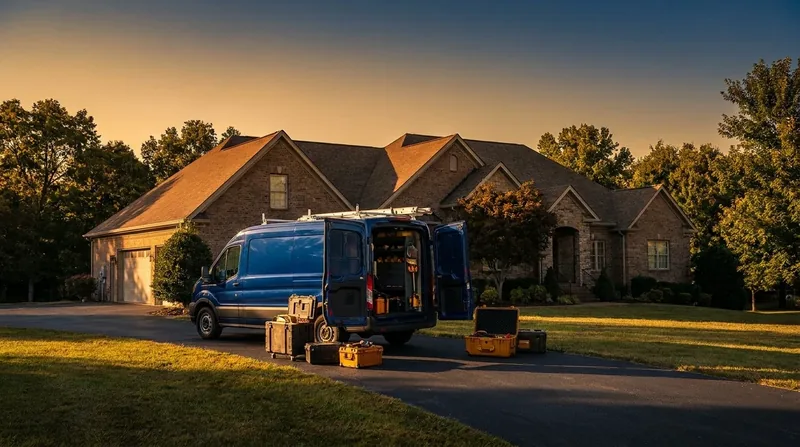
How to Start a Junk Removal Business in Georgia: Hauling Rules, Landfills and Insurance
Learning how to start a junk removal business in Georgia starts with a surprise for most people: the state does not require a junk removal license. There is no state board, no hauling exam and no statewide permit for your truck. The hard parts are elsewhere: filing the right entity with the Secretary of State, getting a local occupation tax certificate from your city or county, finding disposal sites that will accept your loads, and buying insurance that covers a truck full of other people's belongings. This guide covers those pieces in order of importance for a one truck or trailer operation.
Informational content only: This article is not legal or tax advice. Rules change, and your city or county sets its own local requirements. Confirm each item with the agency named before you spend money, and talk with a qualified attorney or CPA if your situation is complex.
What you need before you start
Gather these items before you file anything:
- A truck or trailer you can register and insure for commercial use
- A business name with an LLC or corporate designator, checked against the Secretary of State's records
- A registered agent with a Georgia street address (not a P.O. box)
- A computer or phone to file through the Secretary of State eCorp portal
- A Georgia Tax Center account if you will sell taxable goods or hire employees
- Quotes for commercial auto insurance, general liability insurance and, once you hire, workers' compensation insurance
- Written answers from the county solid waste office and each landfill or transfer station you plan to use
- A simple job log for each load: date, customer, volume, weight ticket and disposal receipt
Step 1: Form your entity with the Georgia Secretary of State
Most one truck operators form a limited liability company. Your formation document is the Articles of Organization. Corporations file Articles of Incorporation instead. Either filing costs $110 total, which is the $100 filing fee plus a $10 service charge, whether you file online or on paper.
File through the Secretary of State eCorp portal at ecorp.sos.ga.gov. Online filings usually take about 7 to 10 business days, and paper filings take about 15 business days. If you need speed, expedited review costs $120 for 2 business days, $275 for same day service if received by noon, or $1,200 for one hour on business days. If you want to hold a name while you prepare the filing, a name reservation lasts 30 days and costs $35.
Check the name rules before you file. The name must contain a limited liability company designator, such as Limited Liability Company, LLC or L.L.C., and it must be distinguishable on the Secretary of State's records. Search existing entries on the business search page first. If you want to start a hauling business in GA under a different name, file a trade name registration separately, which is covered in the tips at the end of this guide.
Every Georgia entity needs a registered agent at a registered office with a Georgia street address. For an LLC, the agent must be an individual Georgia resident or a corporation authorized to do business in Georgia, and the registered office must be the agent's business office. A P.O. box does not qualify, and an entity cannot act as its own registered agent. Changing the agent later costs $5 per entity (minimum $20) plus the $10 service charge.
Calendar the annual registration from day one. Georgia requires it between January 1 and April 1 each year. An LLC files its first annual registration in the year after it forms, and a new corporation files within 90 days of incorporating. The fee is $60, which is $50 plus a $10 service charge. A late filing carries a $25 penalty, and an entity that stays delinquent can be administratively dissolved. Reinstatement costs about $260. Confirm the current window and late penalty with the Secretary of State before you rely on these dates.
On taxes, a typical single-member or partnership LLC pays no Georgia franchise tax. Corporations, and LLCs taxed as corporations, owe a net worth tax of $0 to $5,000 depending on net worth. Income passes through to the owner. For current state tax rates, see our Georgia business taxes guide.
Step 2: Register with the Department of Revenue if you sell taxable goods or have employees
Register through the Georgia Tax Center at gtc.dor.ga.gov if you sell taxable goods or have employees. Sales tax registration is free. Understand what it is and what it is not: it is not a business license. Georgia issues no general statewide business license, and the Secretary of State issues none either.
Junk removal labor is generally not subject to sales tax, but goods are a different matter. If you resell salvaged furniture, appliances or scrap, sales tax can apply to those sales. The state rate is 4%, and combined state and local rates run from 6% to 9% depending on county and city. Atlanta's combined rate is 8.9%. Georgia issues no separate resale permit. The resale instrument is Form ST-5, the certificate of exemption. Check with the Department of Revenue at dor.georgia.gov before you start selling recovered goods.
Step 3: Know that your local occupation tax certificate comes from your city or county
Georgia's local business license is an occupation tax certificate, authorized under O.C.G.A. Title 48, chapter 13. It is issued by the city if your business operates inside city limits, or by the county if you operate in unincorporated territory. A business inside a city pays the city, not the county. Each city and county sets its own formula, deadlines and prerequisites, so there is no single statewide fee to plan around. The full details are in the final section of this guide.
Step 4: Solve disposal before you sell your first job
Disposal is where most of the money and risk in this business sits. Household junk goes to a licensed landfill or transfer station. The county or the private facility operator sets the rules for what the site accepts, whether commercial haulers need an account, and how commercial loads are charged. Georgia has no single set of disposal rules for junk haulers, and the rules you find in one county do not carry over to the next. Do not plan around a tipping fee you read about somewhere else.
Before you take a booking, call three places: the county solid waste office, the landfill or transfer station you plan to use, and any private facility nearby. Ask these questions:
- Does a commercial hauler need an account, a hauler permit or a registration? Ask whether that requirement comes from the county or the facility.
- How is the charge calculated: by weight, by volume or by load?
- What materials does the site refuse, and does it ask for proof of insurance?
- What are the unloading hours, and do you need advance notice?
Construction and demolition debris is handled differently. C&D material is often taken at separate construction and demolition landfills or in separate sections, each with its own acceptance rules. Do not assume a general landfill will take drywall, roofing, lumber or concrete just because it accepts household junk. Ask each site before you haul.
Hazardous waste does not belong in a normal junk load. Paint, solvents, batteries, chemicals, asbestos and medical waste are excluded. Refuse those items, and tell the customer to use a hazardous waste program. Program availability varies by location, so check with your county about what it offers and how to refer customers. Hauler rules for hazardous material also vary by locality, so ask the county how it applies to you.
Keep records for every load. Weight tickets and disposal receipts protect you if a customer disputes a charge or a facility questions what you brought in.
Step 5: Use reuse and recycling to cut disposal volume
Donation centers, scrap metal yards and recycling outlets can take material that would otherwise fill your disposal bill. Usable furniture and household goods may go to a donation center. Metal and clean recyclables may go to a scrap yard or recycler. Ask each outlet what it accepts, because some items, including appliances with refrigerant, may need special handling. These outlets can reduce the volume you pay to dispose of, but the savings depend on the outlets near you and your volume. Track them in your own job log rather than relying on someone else's numbers.
If you decide to resell recovered goods, go back to Step 2 and confirm your sales tax position before you open a sales channel.
Step 6: Keep your scope to hauling
Pure hauling is different from demolition. Removing a shed, tearing out a deck or pulling drywall during a remodel can move you into contracting work. If a customer asks for demolition or structural work, check with the Secretary of State's Professional Licensing Boards Division and your local building department before you offer it. Some of that work may require a contractor license. Do not quote it until you have confirmed the requirement for your specific work.
Step 7: Buy the right insurance
Junk removal insurance in Georgia usually comes down to three coverages:
- Commercial auto insurance. Personal auto policies typically exclude business use. Your truck or trailer needs coverage written for commercial hauling.
- General liability insurance. This covers property damage and injury claims tied to your work on a customer's property, such as a scratched floor or an injury during loading.
- Workers' compensation insurance. Georgia requires it when you have three or more workers, including part-time workers. Count part-time helpers from the first day you hire them.
Get at least two quotes for each policy, and ask each agent to explain the exclusions in writing. Ask specifically whether the policy covers work inside a customer's home or garage, and whether it covers items you did not own. Premiums vary widely with your vehicle, driving record, location and services, so this guide does not list them.
Step 8: Build your quote from real costs
Your quote should cover what each job costs you to complete. Build it from four inputs:
- Truck or trailer volume. Measure your vehicle's capacity in cubic yards, then estimate how much of it each job fills. Many haulers quote by a fraction of the truck, such as a quarter, half or full load.
- Labor. Count crew hours from arrival to departure, including loading, sorting, driving to the disposal site and unloading.
- Fuel and wear. Track miles per job and maintenance costs per mile.
- Disposal. Use the actual charge from the facility for each material type, plus any separate fee for construction and demolition or recycling loads.
Add insurance, vehicle payments, phone and software costs, and a margin for your own time. Do not publish a price built on a disposal charge you have not confirmed. Re-run the numbers whenever a facility changes its charges.
Local certificate, zoning and home operations
Your city or county sets the formula, renewal dates and prerequisites for the occupation tax certificate. Georgia has 159 counties and about 537 cities, and each sets its own rules, so the answer depends on your address. Ask the licensing office what else it requires before you apply, because some localities ask for documents beyond the certificate itself.
If your business has more than 10 employees, you must file an E-Verify affidavit to get the local certificate under O.C.G.A. 36-60-6. Plan for that step as your crew grows.
If you park a truck or trailer at home, check the zoning code and any HOA rules first. Residential zones often limit commercial vehicles and outdoor storage, and some restrict how many commercial vehicles a lot can hold. Storing unhauled items at home, in a garage or on a lot, can also raise zoning questions. Ask the planning or zoning office before you store anything on residential property.
What to realistically expect
A careful start may help you complete your filings, secure disposal access and quote jobs with fewer surprises. It may not produce fast revenue. The timeline depends on Secretary of State processing times, how quickly your county answers disposal and licensing questions, and the demand for hauling in your area. Expect the first several weeks to go to filings, insurance quotes and facility calls rather than paid jobs.
Common mistakes to avoid
- Searching for a state junk removal license. None exists, and that time is better spent on the local certificate and disposal access.
- Quoting jobs before you know the disposal rules and charges.
- Accepting hazardous waste to keep a customer happy.
- Assuming one county's landfill rules apply across Georgia.
- Using a P.O. box as your registered office.
- Missing the April 1 annual registration deadline.
- Hiring part-time help without checking the three-worker workers' compensation requirement.
- Offering demolition or structural work before confirming contractor requirements.
- Running a business truck on a personal auto policy.
Tips for a smoother start
- Visit your disposal site before your first job. Watch how the scale house works and note its hours.
- Photograph each load before pickup, with the customer's permission, to document its condition and contents.
- Write a refusal policy for hazardous, unsafe and unacceptable items, and put it on your booking form.
- Keep entity documents, insurance certificates, disposal approvals and local certificates in one folder that you can find quickly.
- If you plan to use a trade name other than your legal name, note that trade names are filed with the Clerk of Superior Court in the county where the business is chiefly carried on, not with the Secretary of State. The clerk fee is about $165 plus a newspaper publication charge, which you should confirm with the county clerk. Notice runs once a week for two weeks in the county legal organ.
This is informational content, not legal or tax advice. Confirm current fees, deadlines and rules with the Secretary of State, the Department of Revenue, your city or county and each disposal facility you plan to use. Talk with a qualified attorney or CPA before you form your entity or take on demolition work. The Georgia Small Business Development Center at the University of Georgia, at georgiasbdc.org, can also help you plan your startup.
Keep exploring: related Georgia guides
- How to Start a Cleaning Business in Georgia
- How to Start a Landscaping Business in Georgia
- How to Start an Auto Detailing Business in Georgia
- How to Start a Laundromat in Georgia
- How to Start an LLC in Georgia
- Georgia Business License
- Cost to Start a Business in Georgia
- All Georgia business types
- Every Georgia guide in one place