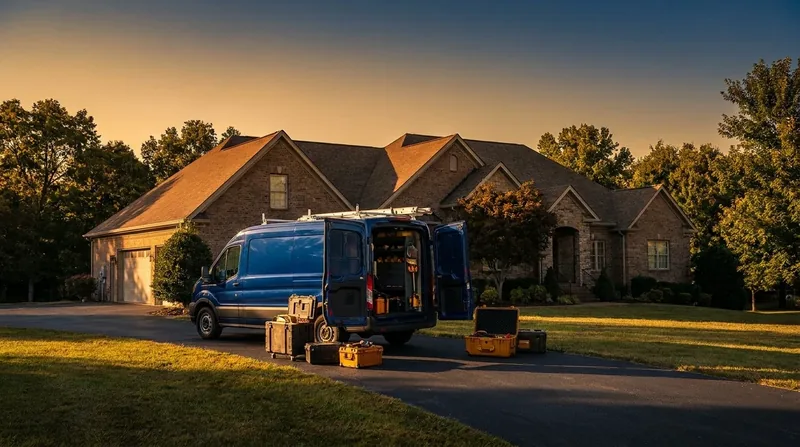
How to Start a Lawn Care Business in Georgia: Pesticide Licenses and Live Plant Rules
Mowing, edging, trimming, and cleanup need no state license in Georgia. The state layer starts when your business applies pesticides, including weed killer mixed into fertilizer, or sells live plants. Every lawn care business also needs a local occupation tax certificate, and that is the license most people mean when they search for a business license for lawn care. It comes from a city or county, not the state. Georgia issues no general statewide business license, so the local certificate is always required and the issuer depends on where you operate. See our guide to Georgia business licenses for how the city and county layers work.
This guide covers the steps in the order most operators should take them: decide which services you will sell, form the business, register for taxes, get pesticide credentials if you spray, get the local certificate, and cover your workers and liability. This article is informational content, not legal or tax advice. Talk with a Georgia attorney and a CPA before you choose an entity, sign client contracts, or set up payroll.
Materials and Information to Gather Before You Start
- A business name checked against Secretary of State records
- An entity choice and a registered agent with a Georgia street address
- A Georgia Tax Center login, if you will sell taxable goods or have employees
- A written list of services, since that list determines which licenses apply
- Your city or county address, to identify which local office issues your certificate
- For spraying: proof of citizenship or legal presence using Secure and Verifiable documents
- For spraying: a registration plan for the Category 24 exams offered through Georgia technical colleges
- Quotes for general liability insurance and, once you reach three workers, workers' compensation coverage
Step 1: Decide Which Services You Will Sell
Your service list drives every other decision, so settle it first. Use this rule of thumb:
| Service | State requirement |
|---|---|
| Mowing, edging, trimming, leaf and debris cleanup | No state license. Entity registration, tax registration if applicable, and the local certificate still apply. |
| Spraying weeds, insects, or disease with any pesticide, including general use products | Commercial Applicator license (Category 24) and Pesticide Contractor license |
| Fertilizer with a weed killer or insecticide in it | That product is a pesticide, so applying it triggers the same two licenses |
| Selling live plants | May require a Live Plant License. Confirm with the Department of Agriculture. |
| Selling mulch, plants, or other materials | Sales tax registration with the Department of Revenue |
A mow-only business needs no state license. Adding a spray service for weeds or pests triggers both pesticide licenses, even if you only use general use products. Licenses follow the activity, not the company name, so running two service lines under one business does not avoid the rules.
Step 2: Form Your Business Entity
Most small operators choose a limited liability company (LLC). Articles of Organization cost $110 total, which is the $100 filing fee plus a $10 service charge. File online through the Secretary of State's eCorp portal at ecorp.sos.ga.gov or on paper. Online filings take about 7 to 10 business days, and paper filings take about 15 business days. Expedited review costs $120 for 2 business days, $275 for same-day review if received by noon, or $1,200 for one-hour review on business days. You can reserve a name for 30 days for $35. The name must include an LLC designator such as LLC and must be distinguishable on the Secretary of State's records. Check the Secretary of State's name rules before you file.
Corporations file Articles of Incorporation for the same $110 total. For a full filing walkthrough, read how to start an LLC in Georgia.
Every Georgia entity must keep a registered agent at a registered office with a Georgia street address. A P.O. box or mail drop will not work. For an LLC, the agent must be a Georgia resident individual or a corporation authorized to do business in Georgia, and the registered office must be the agent's business office. Your business cannot serve as its own registered agent. Changing the agent later costs $5 per entity (minimum $20) plus the $10 service charge.
Both LLCs and corporations file an annual registration of $60 ($50 plus a $10 service charge) between January 1 and April 1 each year. An LLC files its first registration in the year after it forms. A new corporation files its first registration within 90 days of incorporating. A late filing carries a $25 penalty for LLCs. An entity that stays delinquent can be administratively dissolved, and reinstatement costs about $260. Confirm the current window and late penalty with the Secretary of State, then put April 1 on your calendar every year.
Georgia levies no franchise tax on a typical single-member or partnership LLC. Corporations, and LLCs taxed as corporations, owe a net worth tax of $0 to $5,000 depending on net worth. Income from a pass-through LLC is taxed at Georgia's flat individual rate: 5.19% for 2025 and 4.99% for 2026. The rate is flat, not graduated. For corporate income tax details, read Georgia business taxes.
If you will operate under a name other than your registered entity name, you need a trade name (DBA) registration. Trade names are not filed with the Secretary of State. File with the Clerk of Superior Court in the county where the business is chiefly carried on. The clerk fee is about $165, plus a newspaper charge, because notice must run once a week for two weeks in the county legal organ. Confirm the exact clerk fee and publication cost with your county clerk. General guidance is at the Secretary of State's business division FAQ.
Step 3: Register for Taxes With the Department of Revenue
Register through the Georgia Tax Center at gtc.dor.ga.gov if you sell taxable goods such as mulch, plants, or materials, or if you have employees. Sales tax registration is free. Registering for sales tax is not a business license, and it does not replace the local certificate.
The state sales tax rate is 4%. Combined state and local rates run from 6% to 9% depending on county and city, and Atlanta's combined rate is 8.9%. Sales tax applies to goods you sell. Labor for mowing and cleanup is generally not taxed, but invoices that bundle materials and labor need care. Check with the Department of Revenue before you settle how you bill mixed jobs.
Georgia issues no separate resale permit. When a customer or supplier buys goods from you for resale, they provide Form ST-5, the certificate of exemption. Keep these forms on file.
Step 4: Get Pesticide Credentials If You Spray
Anyone who applies any pesticide, general use or restricted use, to another person's property for a fee needs two Georgia Department of Agriculture credentials: a Commercial Applicator license for the individual who applies the product, and a Pesticide Contractor license for the business. Herbicides, insecticides, and fungicides all count. The Department lists a lawn care or maintenance company as an example of a pesticide contractor.
The Commercial Applicator License
- Choose Category 24, Ornamental and Turf. This is the applicator category for lawns.
- Pass two exams. You must pass the general standards exam and the Category 24 exam, each with a score of 70 percent. Georgia technical colleges run the exams at $45 per attempt.
- Plan for retakes. A failed exam can be retaken after waiting until the next month, and no more than twice in six months.
- Pay the license fee. After you pass, the Department charges $90 for the license.
- Document your status. Provide proof of citizenship or legal presence using Secure and Verifiable documents.
- Plan for recertification. Category 24 recertification takes 10 hours.
The Pesticide Contractor License
- The contractor license costs $55 a year and runs on the calendar year. A late renewal adds 50 percent to the fee.
- The business must employ at least one full-time certified commercial applicator.
- The business must meet financial responsibility rules. Georgia requires insurance or a bond, but confirm the required amount with the Department before you buy coverage. Do not assume a figure.
Spraying without the contractor license can bring an injunction and a fine of up to $1,000 per violation. For questions about credentials, contact the Department's Pesticide Program at agpest@agr.georgia.gov.
Step 5: Decide Whether Selling Live Plants Triggers a License
If you sell live plants to customers, you may need a Live Plant License from the Department of Agriculture. Our guide to starting a landscaping business in Georgia covers the fee and details. Confirm current requirements with the Department before you start selling plants, because rules and fees can change.
Step 6: Get the Local Occupation Tax Certificate
The local certificate is an occupation tax certificate, often called a business license, issued under O.C.G.A. Title 48, chapter 13. A city issues it if your business is inside city limits. The county issues it for unincorporated areas. More than half of Georgians live outside any city, so for many lawn care operators the county is the issuer. A business inside a city pays the city, not the county.
Each of Georgia's 159 counties and about 537 cities sets its own formula, deadlines, and prerequisites. Ask the city or county clerk for the current application, fee, and deadline. Employers with more than 10 employees must file an E-Verify affidavit to get the certificate (O.C.G.A. 36-60-6).
Step 7: Cover Your Workers and Liability
Workers' compensation coverage is required once you have three or more workers, and part-time and seasonal workers count toward that number. Plan for your peak-season crew, not your slowest month. See Georgia workers' compensation insurance requirements for details.
Georgia has no state paid sick leave or family leave mandate. Confirm other employment obligations with your attorney or CPA.
Buy general liability insurance before your first paid job. Clients often ask for proof of coverage, and a single mower or spray incident can lead to a claim. Ask an insurance agent which coverages fit a spraying operation. The contractor license's financial responsibility requirement is separate from your general liability policy, so confirm with the Department what it accepts.
What to Expect From a Compliant Lawn Care Program
A compliant setup does not guarantee any particular lawn outcome. Turf results depend on grass type, weather, soil, mowing habits, and the product label. Treatments are designed to help manage specific weeds, insects, or turf conditions, and results often take time to appear and vary from lawn to lawn. Read every label before you apply, follow the label rate and directions, and avoid promising that a product will eliminate a pest or cure a turf problem.
Common Mistakes to Avoid
- Assuming general use products need no license. Any pesticide applied to a customer's property for a fee triggers the credentials.
- Treating the applicator and contractor licenses as one. The individual and the business each need their own license.
- Looking for a state business license. Georgia issues none. The Secretary of State issues none, and the Department of Revenue sales tax registration is not a business license.
- Filing a trade name with the Secretary of State. DBAs go to the Clerk of Superior Court in your county.
- Missing the April 1 annual registration. A late LLC filing carries a $25 penalty, and continued delinquency can lead to dissolution.
- Buying the county certificate for a business inside a city. The city issues the certificate for businesses inside its limits.
- Counting only full-time workers. Part-time and seasonal workers count toward the three-worker workers' compensation threshold.
- Billing mixed jobs without checking tax treatment. Materials and labor can be taxed differently, so confirm with the Department of Revenue.
Practical Tips
- Keep your service list in writing, and update it before you add a spray service.
- Schedule your exams before your busy season, and calendar every renewal date in one place.
- Keep copies of Form ST-5 certificates and your E-Verify and insurance paperwork together.
- Verify every fee on the official agency page before you file, since rules and amounts change.
Official Resources
- Georgia Secretary of State, Corporations Division: sos.ga.gov/corporations-division
- Georgia Secretary of State eCorp filings: ecorp.sos.ga.gov
- Georgia Department of Revenue: dor.georgia.gov
- Georgia Tax Center: gtc.dor.ga.gov
- Georgia Small Business Development Center at the University of Georgia: georgiasbdc.org
This article is informational only and is not legal or tax advice. Fees, deadlines, and rules change, so confirm each figure on the official agency page before you file. For complex situations, including choosing an entity, handling tax on mixed invoices, or meeting pesticide financial responsibility rules, consult a qualified Georgia attorney or CPA.
Keep exploring: related Georgia guides
- How to Start a Laundromat in Georgia
- How to Start a Pest Control Business in Georgia
- How to Start a Landscaping Business in Georgia
- How to Start a Pressure Washing Business in Georgia
- How to Start an LLC in Georgia
- Georgia Business License
- Cost to Start a Business in Georgia
- All Georgia business types
- Every Georgia guide in one place